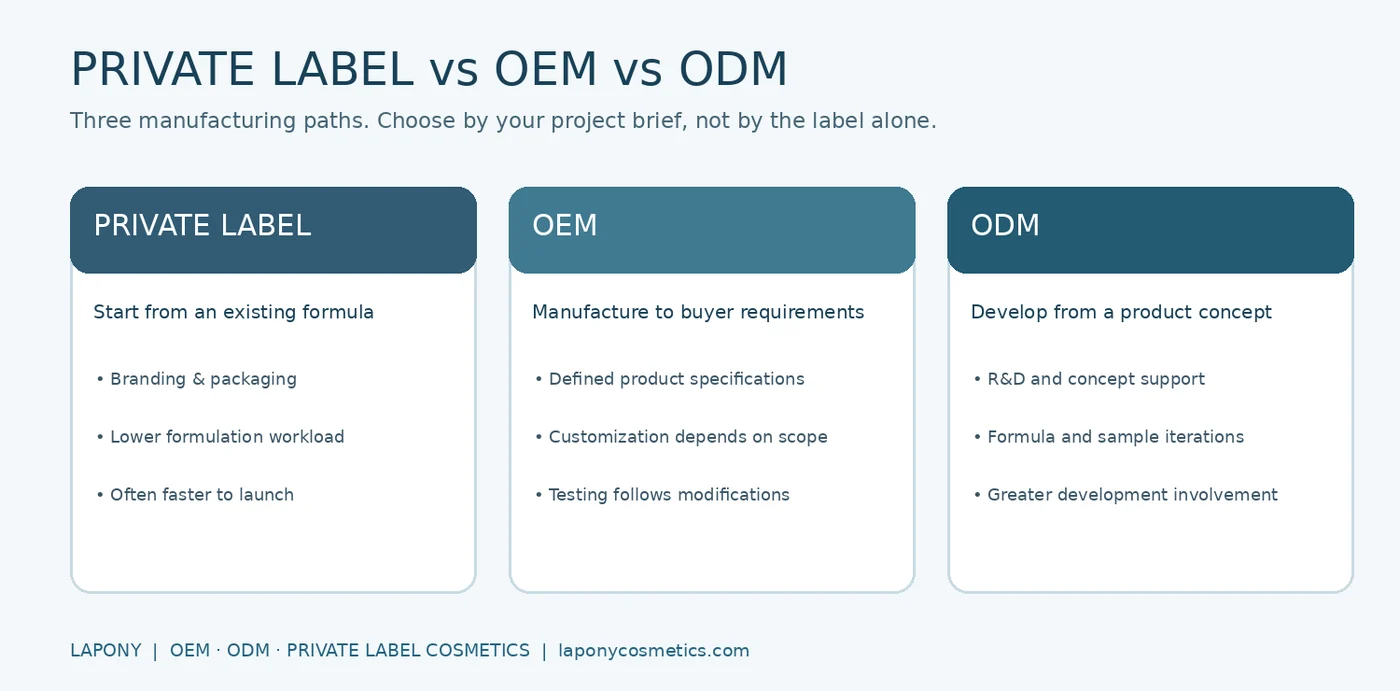
Private label cosmetics generally use an existing manufacturer-developed formula with customized branding. OEM cosmetics are manufactured to a buyer’s defined specifications, while ODM cosmetics typically involve the manufacturer in product design and formulation development.
These terms overlap in practice. The right model depends on formula ownership, customization scope, packaging, MOQ, testing requirements, budget and launch timeline — not the acronym alone.
Quick Answer
Private label is often suitable when speed and a proven formula platform matter most. OEM is useful when the buyer can define product requirements or provide a technical brief. ODM is useful when the brand needs more formulation and product-development support.
Neither OEM nor ODM is automatically cheaper, faster or more differentiated. Packaging MOQ, sample revisions and testing can influence all three models.
Key Takeaways
- Private label usually starts from an existing formula with branding customization
- OEM generally follows buyer-defined specifications
- ODM typically includes manufacturer-led formula and sample development
- Supplier definitions vary — request a written scope of work
- MOQ is driven by formula, packaging, decoration and filling, not by the acronym
- Even a small formula change can require extra testing
What Is Private Label Cosmetics?
Private label cosmetics usually begin with a formula already developed by the manufacturer. A buyer selects a product platform and customizes the brand presentation: logo, label, bottle or tube, decoration and carton. Some manufacturers also offer limited formula adjustments, subject to technical evaluation.
This route can suit distributors expanding their portfolio, established brands testing a new category and first-time brands managing development risk. “Existing formula” does not mean that all finished products are identical: fragrance, presentation, packaging and brand positioning may still differ, depending on the approved scope.
What Is OEM Cosmetics Manufacturing?
OEM (Original Equipment Manufacturing) generally means manufacturing according to buyer-defined requirements. These may include target ingredients, product performance, viscosity, texture, fragrance, packaging, size, specifications and acceptance criteria. The manufacturer evaluates feasibility, produces samples and manufactures the agreed product.
An OEM project can use an existing platform or a more customized formula. Buyers should confirm who owns the formula, who supplies specifications, who is responsible for testing, and whether the quotation includes packaging and design.
What Is ODM Cosmetics Manufacturing?
ODM (Original Design Manufacturing) typically includes deeper manufacturer-led development. The brand may start with a concept such as “a lightweight barrier-support serum for hot, humid climates.” The development team helps turn that brief into ingredient direction, sensory targets, formulation, sample iterations and suitable packaging.
ODM is valuable when the brand knows its consumers and desired positioning but needs technical formulation support. It is not necessarily the most expensive route: a modest adaptation of a mature base can be simpler than a technically demanding OEM specification.
Private Label vs OEM vs ODM: Side-by-Side Comparison
Private Label
- Starting point: existing formula
- Formula work: none to limited
- Packaging: usually customizable
- Sampling: often fewer revisions
- Best fit: speed / portfolio test
OEM
- Starting point: buyer specifications
- Formula work: depends on the brief
- Packaging: per specification
- Sampling: depends on complexity
- Best fit: defined requirements
ODM
- Starting point: brand concept / brief
- Formula work: manufacturer-led development
- Packaging: developed with the project
- Sampling: often iterative
- Best fit: concept needing R&D
These are common commercial patterns, not universal definitions. Request a written scope of work from each supplier. MOQ, timeline and cost are packaging- and process-driven in all three models.
How Do MOQ, Sampling and Packaging Change the Decision?
MOQ is not determined by the words private label, OEM or ODM. It may be driven by bulk-formula batch size, filling equipment, standard versus custom packaging, decoration method, carton printing and number of SKUs or shades. A standard bottle can sometimes support a lower starting quantity than a completely custom mold.
For many standard-packaging skincare projects, Lapony may evaluate quantities around 1,000 units per SKU; custom bottles, sunscreen and color cosmetics can require substantially higher quantities. These are project-dependent starting points, not universal quotations. Confirm the finished-product MOQ in writing.
Which Manufacturing Model Should an Established Beauty Brand Choose?
For an established distributor launching a new shampoo line, a private label platform can shorten early product selection. For a skincare brand with a detailed formula and packaging specification, OEM may offer a clear production brief. For a brand creating a differentiated serum for a particular climate and consumer need, ODM may be more appropriate.
The best commercial choice is the route that produces a stable, market-appropriate product at a workable landed cost — not simply the route that sounds most customized.
Can You Modify an Existing Cosmetic Formula?
Often, but not every change is technically minor. Fragrance, color, viscosity, pH, active ingredients, preservative system and packaging compatibility interact. Even a seemingly small adjustment can trigger additional stability, compatibility or other appropriate testing. Agree on the acceptance criteria and sample revision process before bulk production.
What Information Should You Send a Cosmetics Manufacturer?
- Product category and intended benefits
- Target market, consumer and sales channel
- Formula concept or reference product
- Preferred ingredients and restricted ingredients
- Texture, fragrance, color and size
- Packaging reference and decoration requirements
- Estimated order quantity and number of SKUs
- Target EXW price range and desired launch timing
- Testing, documentation and labeling requirements
Buyer Scenario: A Lightweight Recovery Serum
A beauty brand plans a 50 ml recovery serum for a hot and humid market. It wants fast absorption, a comfortable non-sticky finish and a clear barrier-care positioning. If an existing formula already meets the brief, private label may be efficient. If the buyer provides a finished technical specification, OEM may fit. If the concept still needs ingredient selection, texture trials and sample refinement, ODM may provide the most value.
This is an illustrative scenario, not a claim of specific product efficacy.

Frequently Asked Questions
Is private label the same as OEM cosmetics?
Not always. Private label typically uses an existing formula with brand customization; OEM more often follows buyer-defined manufacturing specifications. Supplier definitions vary.
Is ODM better than OEM for a skincare brand?
Neither is universally better. ODM can provide greater development support; OEM may be more suitable when the buyer already has precise specifications.
Does private label always have a lower MOQ?
No. Standard packaging can help, but formula batch size, bottles, printing, cartons and filling requirements determine the workable MOQ.
Can I customize active ingredients in a private label formula?
Sometimes. Changes to ingredients or concentrations require formulation review and may need additional testing.
How long does OEM or ODM cosmetic development take?
It depends on the formula, sampling rounds, packaging procurement, testing and production schedule. Request a stage-by-stage timeline.
Who owns an OEM or ODM cosmetic formula?
Formula ownership, exclusivity, intellectual property and disclosure depend on the contract. Confirm these terms before development.
Can one supplier manufacture skincare, sunscreen and makeup?
Some manufacturers support multiple categories, but production equipment, testing and compliance requirements differ. Verify category-specific capability.
Related guide: How to Choose a Cosmetics Manufacturer in China
Why Work With Lapony Cosmetics?
Lapony supports private label, OEM and ODM cosmetics projects across skincare, sunscreen, hair care, body care and color cosmetics. Our team can evaluate formula direction, packaging feasibility, samples, production requirements and project-specific MOQ.
Explore products · OEM/ODM services
Develop Your Beauty Products With Lapony
Share your product category, size, target market, expected quantity and packaging reference to discuss a suitable development route.
Get A Free Quote